ERP implementation partner due diligence: verify the delivery team
Evaluate an ERP partner using the proposed team, relevant workflow evidence, scope clarity, resource commitments, and support handover rather than broad claims.
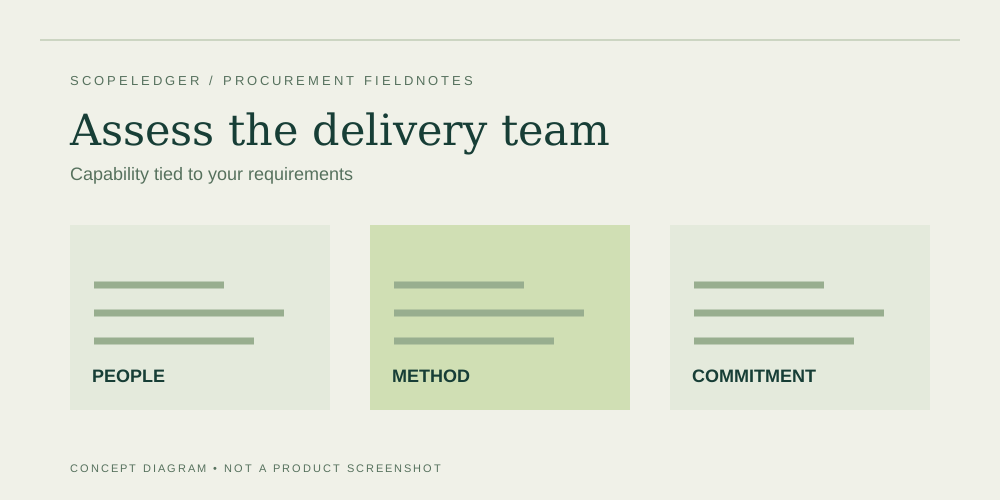
Evaluate an ERP implementation partner by the team and delivery approach proposed for your project. Ask for relevant workflow evidence, a clear statement of work, buyer resource requirements, escalation procedures, and a support handover. A product partnership label or a persuasive reference is useful context, but neither proves that the proposed team can deliver your specific scope.
Start with the actual delivery roles
Identify the project lead, functional consultants, migration lead, integration specialists, trainers, and support contacts. Ask which roles are committed, which are provisional, and how substitutions are handled. A successful discovery meeting with a senior salesperson does not establish who will configure the system or resolve a critical interface defect months later.
Request a resource plan aligned with milestones and your own team's availability. Understand whether key specialists are shared across projects and how scheduling conflicts are resolved. Avoid demanding irrelevant personal information; focus on role capability, relevant work, availability, and continuity. If resumes or credentials are provided, verify material claims through appropriate official or authorized channels rather than reproducing them as site endorsements.
Ask for evidence tied to your requirements
| Requirement | Useful partner evidence |
|---|---|
| Complex inventory flow | A demonstration of the actual exception path |
| Data migration | Mapping, rehearsal, and reconciliation approach |
| Integration | Failure handling and operating ownership |
| Financial controls | Role design and tested approval behavior |
| Training | Role-based materials and practice plan |
| Support | Triage, escalation, and handover procedure |
Ask what was delivered by the proposed team versus another team in the same firm. Where references are offered, use an authorized conversation and ask about scope, buyer effort, changes, and support. Do not treat a reference as a statistically representative review. A positive project in another industry can still leave important questions about your own workflows and constraints.
Examine how the partner handles uncertainty
A credible proposal should expose assumptions and exclusions. Ask how incomplete requirements are resolved, how estimates are revised, and how change requests are approved. Request an example structure for a design decision, status report, issue log, and forecast to complete. The point is to understand the management process, not to collect polished documents nobody will use.
For a time-and-materials engagement, examine the rate card, approval process, time records, forecast, and stopping rules. For a fixed-fee engagement, inspect quantities, deliverables, acceptance criteria, and buyer dependencies. Do not compare the labels alone. A fixed fee with vague exclusions can be less predictable than a bounded work package with transparent effort tracking, depending on the actual terms.
Validate escalation and support boundaries
Ask what happens when a problem spans the product publisher, partner extension, integration provider, and customer configuration. Who owns triage and communication? Which issues are included in support, and which become billable project work? Clarify support hours, contact routes, and response commitments in the agreement. A response target is different from a guaranteed resolution time.
Review handover before launch. The operating team needs configuration documentation, integration details, credentials under appropriate control, known issues, and procedures for common exceptions. If knowledge remains with one consultant, the buyer may face avoidable dependence. Plan cross-training and documentation as deliverables rather than hoping they appear during the final week.
Make a balanced appointment decision
Compare relevant capability, scope clarity, availability, communication, risk handling, and cost. Avoid unsupported rankings or a single weighted score that conceals a mandatory gap. If one partner is preferred despite an unresolved dependency, state the condition and the evidence required before commitment. Have procurement and counsel review material contractual and commercial provisions.
After appointment, keep the evidence and assumptions in the project baseline. Revisit commitments when team members, scope, or timing change. Due diligence is not a one-time presentation exercise; it creates the expectations against which delivery can be managed. A strong relationship benefits from clear responsibilities and visible decisions, including candid acknowledgement of work the buyer must perform.
Approval worksheet
Before appointment, ask the proposed project lead to walk through one difficult scenario from your scope. It might be an unreconciled migration, a failing interface near launch, or an unavailable buyer approver. Look for a clear escalation path, evidence-based decisions, and an explanation of buyer responsibilities. This is a working conversation about delivery, not a request for a guarantee that problems never occur.
Reconcile the answers with the statement of work and resource plan. If the approach depends on a specialist, verify availability and substitution arrangements. If it depends on buyer cleanup or testing, reserve that capacity internally. Record any material promise in the appropriate commercial or delivery document. During implementation, review whether the agreed team and methods remain in place. When circumstances change, update the plan openly rather than allowing the original due-diligence conclusions to stand after their supporting assumptions have disappeared.
FAQ
Does partner status guarantee a successful project?
No. Verify what any claimed status means through the relevant official program, then assess the proposed team's fit, availability, scope, and delivery evidence. Status does not replace project-specific due diligence.
Should we choose the lowest hourly rate?
Compare the complete proposed effort, roles, assumptions, management process, and expected deliverables. A lower rate does not establish a lower total or an acceptable delivery approach. Avoid unsupported assumptions about productivity.
Are customer references enough?
They are one input. Ask about comparable workflows, buyer effort, changes, and support, and obtain separate evidence for your own requirements. Never invent or publish reference quotes without authorization.
Sources
- Microsoft Business Central pricing — official partner purchase and assessment routes; no partner is ranked or endorsed here.
Continue the workbook
- ERP project risk register: turn concerns into actions
- ERP exit planning: test the export before you need it
- ERP go-live support: budget for stabilization and ownership
Use the ERP total cost calculator for your own scenario, the quote readiness checklist to track evidence, and the cost structure comparison to review purchasing models.