ERP exit planning: test the export before you need it
Plan ERP exit around usable records, attachments, reference keys, access windows, integration handover, and priced transition support.
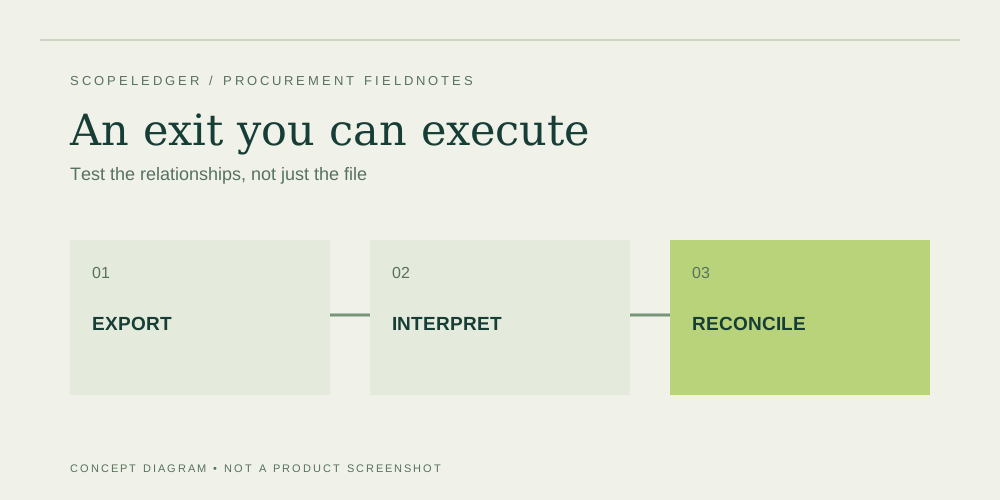
Plan an ERP exit before signing by identifying what you must retrieve, in what format, by when, and with whose help. Test a representative export and its relationships rather than accepting a promise that “your data is portable.” Include attachments, audit information, configuration, integrations, and the access period needed for transition and retention obligations.
Inventory the records and dependencies
List master data, transactions, opening and closing balances, attachments, reference keys, audit records, report definitions, and configuration needed for a replacement or archive. The required set depends on business, legal, accounting, and operational needs. An export of flat tables may be technically complete while failing to preserve the relationships that make the records understandable.
Map integrations and third-party extensions. Some data or configuration may sit outside the core ERP, and a partner may control middleware accounts or custom code. Determine who owns each component, who can access it, and what rights you have to continue using or transferring it. Do not assume a core-system cancellation automatically ends every connected service or gives you rights to another supplier's intellectual property.
Request a sample export
| Test | What to verify |
|---|---|
| Record completeness | Agreed entities and date ranges are present |
| Relationships | Orders, lines, invoices, and attachments can be linked |
| Financial reconciliation | Exported totals match approved source totals |
| Usability | Another tool can open and interpret the format |
| Access control | Sensitive exports have appropriate handling |
| Repeatability | The process can be rerun with documented steps |
Use a representative set containing corrections, reversals, partial transactions, and attachments. A handful of clean customer rows does not prove that complex history can be reconstructed. Have the intended archive or replacement team review the output. Record field definitions and any transformations needed to make the data usable outside the application.
Clarify access and assistance terms
Ask when access ends after termination, whether read-only access is available, what export tools remain usable, and whether assistance is charged. Determine how requests are made and how long a large export may take. Confirm whether there are separate deadlines for retrieving backups or requesting deletion. Counsel should review the binding terms and any material ambiguity.
Do not rely on a salesperson's statement that exports are “easy.” Request a procedure, scope, and commercial treatment. If professional services are needed, ask for a rate basis and an estimate for the defined task. Keep those costs in an exit scenario. They do not necessarily belong in the initial cash budget, but they affect the practical flexibility of the purchase.
Model transition costs transparently
For illustration, suppose an export and reconciliation exercise costs a fictional $4,000, three months of read-only service costs $500 monthly, and archive setup costs $2,500. The selected exit lines total $8,000. This excludes the replacement implementation, internal work, and any overlapping integrations. It is not a typical exit price or an estimate for a named ERP product.
Review what happens to integrations during transition. Decide when writes stop, how outstanding transactions are completed, and how duplicate processing is prevented. Keep a controlled list of credentials and accounts to remove after reconciliation. The ability to retrieve data is important, but an orderly exit also requires the business to finish work and establish a new authoritative system.
Keep the plan usable while you stay
Update the exit inventory after major modules, entities, or integrations are added. Periodically test that your team can still produce and interpret the necessary exports. Documentation can drift as fields and extensions change. The purpose is not to assume that the relationship will fail; it is to preserve operational options and reduce dependence on undocumented knowledge.
Consult records, legal, privacy, and accounting owners about retention and deletion obligations. Those decisions may conflict with an instinct to retain everything forever or erase everything immediately after termination. Document who approves the final archive and who confirms that unnecessary copies and access are removed. A tested exit plan turns portability from a marketing claim into a repeatable operational capability.
Approval worksheet
Include the export exercise in the acceptance plan while the implementation team still understands the data model. Ask a reviewer outside the original configuration team to locate a selected transaction, its lines, related records, and attachment using the exported material. Document what additional definitions or tools are needed. A process that only one consultant can interpret is not yet a robust handover.
Keep the latest tested procedure and responsible contacts in the operating documentation. Review access windows and assistance terms before renewal so the organization understands its practical options. If a supplier changes an export format or an extension adds records, update the test. When an actual exit begins, approve a final reconciliation and access-removal plan. Preserve required records securely, remove unnecessary credentials, and obtain the appropriate confirmations rather than assuming that terminating billing completes the operational and data transition.
FAQ
Is a CSV export enough?
It may be enough for a particular data set, but check relationships, field definitions, attachments, history, and reconciliation. File format alone does not establish that the export is complete or useful.
Should we request source code?
Only where relevant to custom components and the agreed rights. Standard product code and partner-developed extensions can have different terms. Have technical and legal advisers identify the rights needed for support and transition.
Does deletion end retention obligations?
Do not assume that. Retention and deletion requirements depend on the records and applicable obligations. Ask the organization's legal, privacy, and accounting owners to define the appropriate treatment.
Sources
- NIST Small Business Cybersecurity Corner — resources for reviewing access and data-handling controls during transition.
Continue the workbook
- ERP project risk register: turn concerns into actions
- ERP go-live support: budget for stabilization and ownership
- ERP implementation partner due diligence: verify the delivery team
Use the ERP total cost calculator for your own scenario, the quote readiness checklist to track evidence, and the cost structure comparison to review purchasing models.