ERP project risk register: turn concerns into actions
Create an ERP risk register with causes, consequences, owners, evidence, and response plans for scope, data, integrations, access, and launch.
An ERP risk register should identify what could prevent the project from meeting its objectives, why that could happen, and what the team will do about it. Give each risk an owner, response, evidence requirement, and decision point. A list of alarming labels is less useful than a small set of specific risks that people can act on.
Write risks as cause and consequence
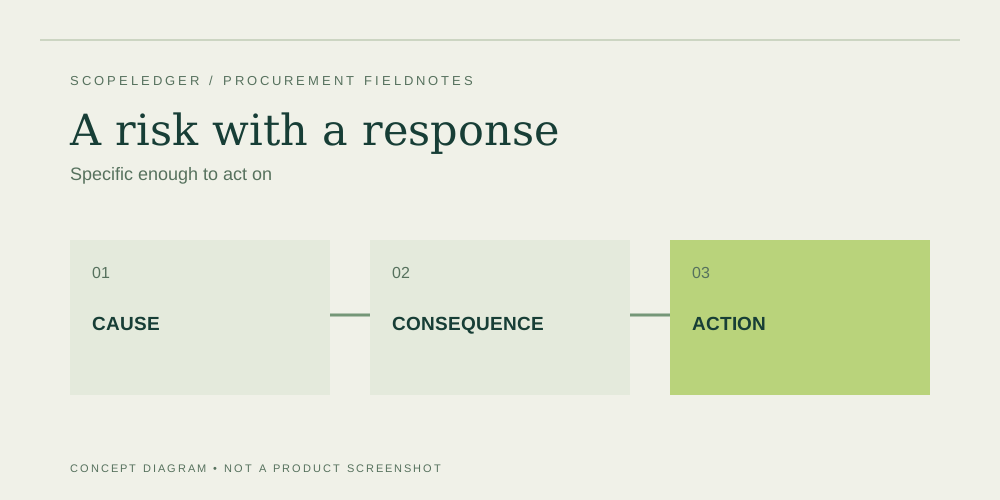
“Data risk” is too broad. A more useful statement is: customer duplicates remain unresolved, so migration may create conflicting accounts and delay order processing at launch. That statement identifies a cause, a possible event, and a business consequence. It also points toward a response: cleanup ownership, duplicate rules, rehearsal evidence, and a launch criterion.
Separate risks from issues. A risk may occur; an issue has already occurred. If an integration test has failed, record the issue, its corrective action, and any remaining risk to the schedule. Keeping a known failure in a generic risk list can delay the concrete work needed to fix it. Likewise, an accepted limitation should have a documented operating response rather than remaining an ambiguous warning forever.
Use a practical register structure
| Field | What to write |
|---|---|
| Cause and event | The condition and what might happen |
| Consequence | The business effect if it happens |
| Owner | A person or role able to drive a response |
| Response | The next preventive or contingency action |
| Evidence | The test or document that reduces uncertainty |
| Decision point | When escalation or approval is required |
You can add qualitative impact and likelihood if the organization uses them consistently. Avoid invented percentages without evidence. A red, amber, or green status should be supported by criteria and current information. The color alone does not explain whether the team is waiting on a document, a technical test, or an executive choice.
Start with the dependencies in your own plan
Review mandatory scope, buyer staffing, data, integrations, roles, testing, training, cutover, and support. Ask where success depends on an unverified assumption. For example, the project may assume a supplier API can provide a required field, a controller can approve mapping during close, or a partner can supply a specialist at launch. Each assumption should have evidence or a follow-up.
Do not copy a long generic register and call the project assessed. Select risks tied to actual workflows and commitments. A manufacturing business with lot traceability needs different tests from a professional-services firm billing projects. The exercise should reveal the team's own constraints. Where security, privacy, accounting, or legal consequences are material, involve the relevant specialists rather than relying solely on project scoring.
Connect risk responses to cost and schedule
A response can require a rehearsal, prototype, additional resource, contract clarification, or a change in rollout approach. Price and schedule the agreed action. A budget reserve without an action plan may fund later work but does not reduce uncertainty today. Conversely, a bounded discovery task can replace a vague risk with a better estimate and a clearer decision.
For an illustrative example, a critical interface has no tested recovery process. The response might be a fixed-scope test of outage, retry, and reconciliation before design approval. If that test is not complete, the project can delay approval or explicitly accept a documented consequence. Do not invent an expected loss amount merely to claim that testing produces a precise return on investment.
Review evidence at real decision points
Review material risks before scope approval, commercial commitment, configuration freeze, migration rehearsal, and launch. Update the evidence and response rather than just the status color. If a risk is closed, record why: a successful test, an approved scope change, or a deliberate acceptance by the accountable owner. “Discussed in meeting” is not a closure reason.
Escalation should describe the decision required. “Integration risk remains high” is less actionable than “the supplier has not demonstrated duplicate prevention; approve a two-week test or change the launch scope.” Record accepted risks with the approver and the conditions of acceptance. If those conditions change, reopen the decision. This keeps the register aligned with reality rather than becoming a historical presentation appendix.
Approval worksheet
At each review, choose the most consequential open uncertainty and ask what new evidence has arrived since the last meeting. If nothing has changed, decide whether the next action is inadequate, blocked by a dependency, or waiting for authority. Repeating the same status language does not advance the response. Escalate a specific choice with consequences and options.
Check whether the response creates a new risk elsewhere. Delaying a migration test may preserve design capacity now while concentrating work near launch; adding customization may solve a workflow gap while increasing maintenance obligations. Record those tradeoffs openly. Before handover, transfer residual risks to the operational owners who can manage them. Include the evidence, accepted conditions, review triggers, and outstanding actions. A risk should not disappear merely because the implementation project closes or because its former owner moves to another assignment.
FAQ
How many risks should the register contain?
Enough to represent the material uncertainties in the actual project. A concise register with accountable actions is more useful than dozens of copied entries nobody reviews. Keep detailed issues in a linked issue log.
Should every risk have a financial value?
No. Use a monetary estimate only when its basis is defensible. Operational disruption, legal questions, and control gaps can be described with clear consequences and approval criteria without fabricated probabilities.
Who can accept a risk?
The role authorized by the organization for that consequence. A project manager should not silently accept a security, financial-control, or legal exposure on behalf of an owner who has not reviewed it.
Sources
- NIST Small Business Cybersecurity Corner — resources for the security portion of a broader ERP risk review.
Continue the workbook
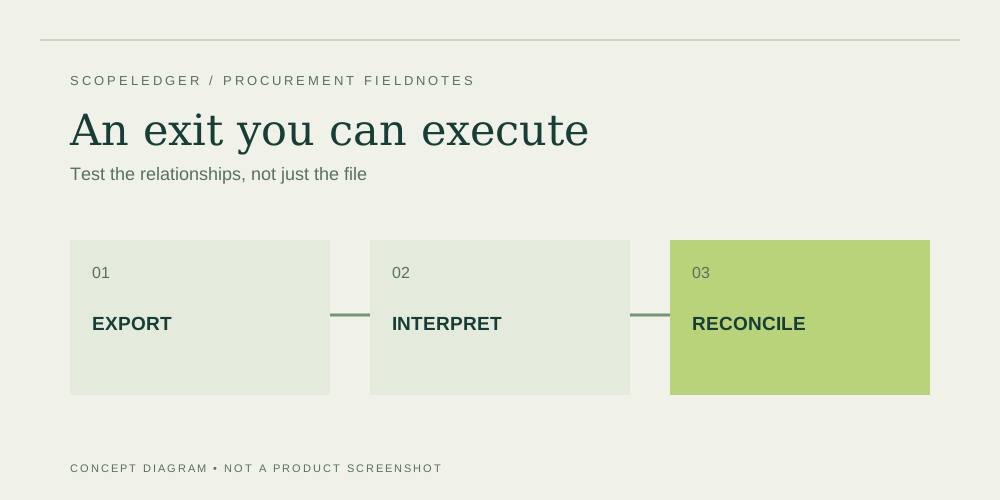
- ERP exit planning: test the export before you need it
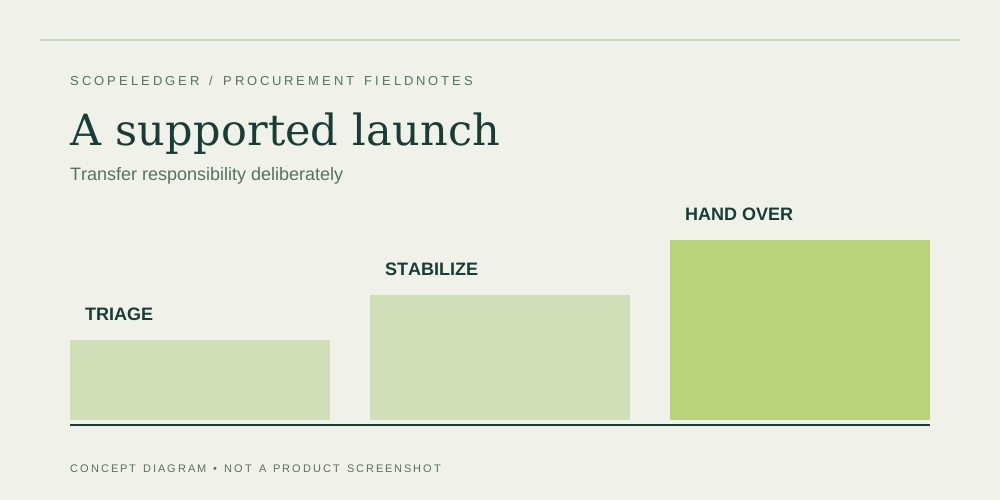
- ERP go-live support: budget for stabilization and ownership
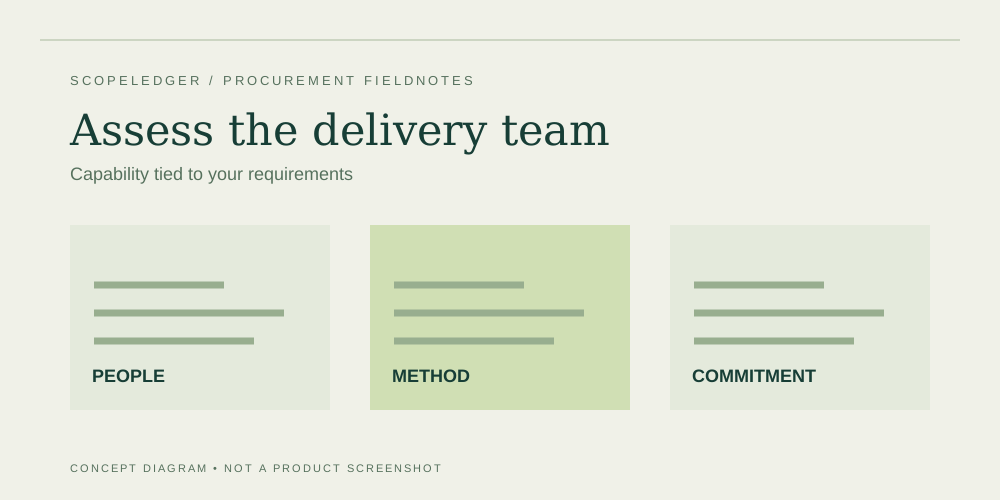
- ERP implementation partner due diligence: verify the delivery team
- ERP scope creep: a change request that protects the budget
- ERP security due diligence: ask for evidence and owners
Use the ERP total cost calculator for your own scenario, the quote readiness checklist to track evidence, and the cost structure comparison to review purchasing models.