ERP go-live support: budget for stabilization and ownership
Define ERP launch support around triage, business reconciliation, access, defect handling, training gaps, and a clear handover to steady-state operations.
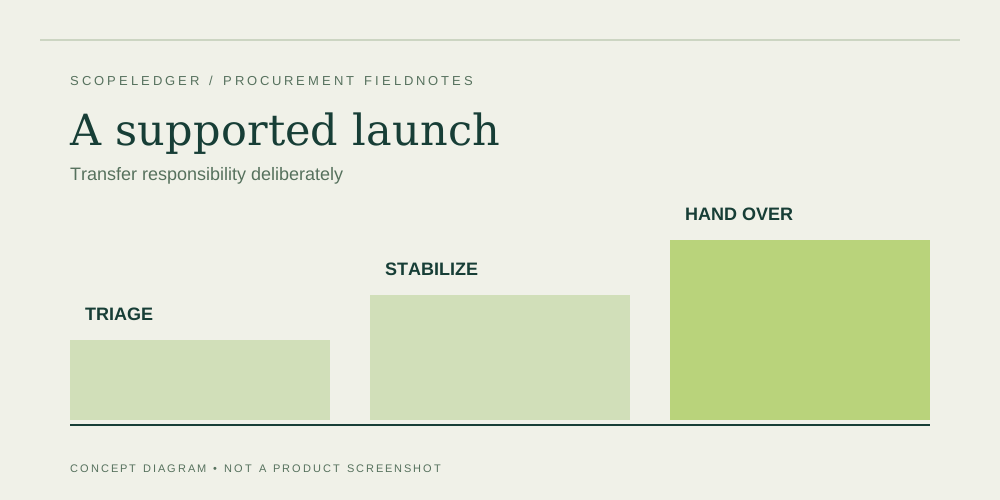
Budget ERP go-live support as a defined stabilization service with named owners, triage rules, coverage, and exit criteria. Launch is not the end of implementation work. The organization needs a reliable way to distinguish defects, access problems, data exceptions, integration failures, and training questions while keeping critical business processes operating.
Define what stabilization is meant to achieve
Set the period and objectives in the delivery plan. Objectives might include completing the first close, reconciling opening data, processing critical workflows, and transferring routine support to the operating team. Use measurable evidence rather than assuming that a fixed number of days means the system is stable. The appropriate duration depends on the processes and issues in your project.
Identify operational peaks. A warehouse may need support during receiving and shipping shifts, while finance needs coverage for its first close. A generic office-hours support arrangement may not match those needs. Ask who is available, which roles they cover, how incidents are raised, and what happens outside the agreed window. Price the coverage actually required, not a reassuring label such as “hypercare.”
Build one triage process
| Issue type | Initial owner | Evidence to capture |
|---|---|---|
| Access | Identity or application administrator | User, role, denied action |
| Process question | Trained process owner | Intended task and observed result |
| Data exception | Data owner | Record, source, and reconciliation impact |
| Integration failure | Interface operations owner | Event, error, retry, and status |
| Product defect | Partner or publisher route | Reproducible steps and expected behavior |
Use a single issue register with appropriate access controls. Capture business impact, affected users, workaround, owner, next action, and status. Avoid circulating unnecessary personal or financial data in screenshots. A shared inbox can be a contact route, but it should not become an unstructured archive where multiple people assume someone else is acting.
Distinguish response, resolution, and workaround
Review the meaning of support commitments. A response can acknowledge an issue without restoring the process. A workaround can allow operations to continue while the defect remains open. Define who approves a workaround and how its records will be reconciled later. Temporary spreadsheets and manual postings should have controls, owners, and a retirement plan.
Agree severity criteria based on business impact. A stopped shipping process may require a different response from a cosmetic report defect. Avoid marking every issue critical, which weakens prioritization. Likewise, do not downgrade a financial-control problem simply because users can technically keep entering transactions. Include the appropriate business owner in deciding the consequence and response.
Price coverage and knowledge transfer
An illustrative launch support package might reserve ten consultant days at a fictional $1,200 per day, plus $2,000 for training refreshes. The selected subtotal is $14,000. That example does not establish a standard rate or recommended duration. Confirm whether travel, extended hours, integration specialists, and follow-up fixes are included or separately charged.
Include internal staffing. Superusers and process owners need time to answer questions, validate workarounds, and reconcile data. If those people are also doing their normal jobs, plan backfill or reduced workload. A supplier's support presence cannot replace buyer decisions about correct master data, approval authority, or the business meaning of an exception.
Agree the exit from launch support
Define the conditions for moving to steady-state support. These might include approved reconciliation, completed critical test outcomes, a manageable issue backlog, documented workarounds, trained administrators, and confirmed support contacts. The exact criteria should be agreed for your project. A calendar date can trigger a review, but should not silently close unresolved responsibilities.
At handover, transfer configuration records, integration procedures, access administration, recurring tasks, known issues, and supplier contacts. Confirm the commercial support arrangement that begins next and how unresolved implementation defects are treated. Review budget and resource assumptions after the first operating cycle. The aim is an accountable ongoing service, not a launch celebration followed by a support gap.
Approval worksheet
Rehearse the first support day before launch. Submit a sample access issue, a rejected interface event, and a process question through the intended channels. Check that each reaches an owner with enough information to act. Confirm that users know which contact route to use and that support staff can see the relevant documentation without receiving excessive privileges.
At the stabilization review, examine the pattern of incidents as well as their count. Repeated training questions may indicate unclear materials, while recurring data exceptions may need a master-data correction. Close the underlying cause where practical rather than repeatedly applying a manual fix. Before the partner reduces coverage, confirm the backlog owners and support terms in writing. Keep a clear record of unresolved defects, accepted workarounds, and the next review. The operating team should receive both the knowledge and authority needed to sustain the service after the project handover.
FAQ
Is launch support usually included in implementation?
Do not assume it. Read the scope for days, roles, hours, activities, exclusions, and exit criteria. A reference to support can mean different things in a project statement and a recurring service agreement.
Should every issue be fixed before support handover?
That depends on severity and agreed criteria. Residual issues need owners, treatment, and a plan. Critical unresolved controls or unusable mandatory workflows should be escalated to the authorized business owners.
Can superusers replace the partner support team?
They can handle some process questions when trained and available. They do not automatically have the technical access, contractual responsibility, or specialist knowledge to resolve product, integration, and infrastructure defects.
Sources
- NIST Small Business Cybersecurity Corner — resources to consult for access and incident-related responsibilities during the operating handover.
Continue the workbook
- ERP project risk register: turn concerns into actions
- ERP exit planning: test the export before you need it
- ERP implementation partner due diligence: verify the delivery team
Use the ERP total cost calculator for your own scenario, the quote readiness checklist to track evidence, and the cost structure comparison to review purchasing models.