ERP integration costs: budget beyond the connector
Estimate ERP interfaces by data flow, failure handling, monitoring, ownership, and change impact rather than a connector name alone.
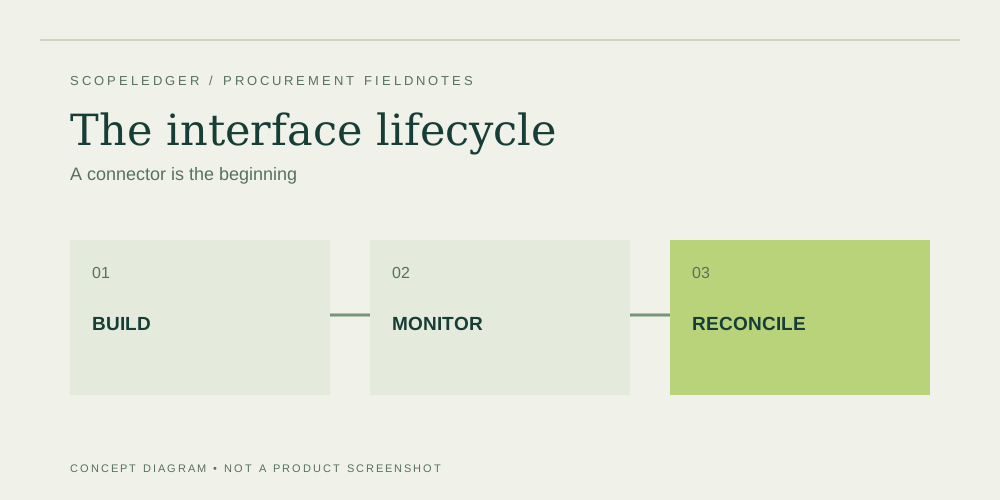
An ERP integration budget should include design, build or subscription, testing, monitoring, exception handling, and future changes. A connector's existence does not prove that your required workflow is covered. Specify the business event, data direction, timing, reconciliation, and recovery method before asking for a price.
Inventory flows rather than application logos
Draw each business event separately. An ecommerce order entering ERP, a shipment confirmation returning to the store, and a refund reaching accounting are three flows even if one connector supports all three. Record the source of truth for customers, items, prices, inventory, and financial status. If two systems can edit the same field, the design needs a conflict rule rather than an assumption that the latest update is correct.
Volume matters, but so do timing and consequences. A nightly supplier catalog update has a different operational requirement from a credit check that must finish during order entry. Identify normal and peak volumes, expected latency, historical backfill, and what the business does while the interface is unavailable. Put those requirements into the scope so a low connector subscription does not conceal a manual workload.
Price the whole operating chain
| Cost line | Design question | Owner to confirm |
|---|---|---|
| Connector subscription | Which flows and volume are included? | Procurement and vendor |
| Mapping and build | Who owns transformation rules? | Integration lead |
| Platform operations | Who monitors jobs and credentials? | IT operations |
| Error resolution | Who corrects rejected records? | Business process owner |
| Change testing | Who retests after either system changes? | Application owners |
Avoid assigning all interface ownership to “IT.” IT may run the job but lack authority to decide whether an invalid tax code or customer account should be corrected. Name the operational decision maker and escalation path. Include the permissions and audit trail needed for any manual correction, especially where financial postings or inventory adjustments are involved.
Model one interface carefully
Consider an illustrative link between a store and ERP. Initial mapping and tests cost $5,000, a connector costs $150 monthly, and monitoring effort is valued at $200 monthly. Over three years, the modeled total is $5,000 + 36 × ($150 + $200) = $17,600. All amounts are chosen examples. They do not represent a vendor offer, a staffing benchmark, or a quote for your system.
Now add an illustrative $2,400 annual allowance for retesting and changes. Three-year cost becomes $24,800. That allowance should eventually be replaced by a specific maintenance scope, actual effort estimate, or approved contingency. Do not present it as a market standard. Also check whether the connector already includes some support or monitoring so that the same service is not counted twice.
Demand failure demonstrations
Test a duplicate event, an invalid account, an expired credential, a temporary outage, a partially processed batch, and a retry after recovery. Require the team to explain how duplicate posting is prevented and how incomplete records are reconciled. A smooth demonstration of one successful order does not test the most expensive operational work: figuring out what happened when something failed.
Use sanitized test data and confirm who can access logs. Logs can contain personal or commercial information, so retaining everything forever is not a neutral decision. Review appropriate retention and access with your security and privacy owners. The NIST small-business cybersecurity resources provide a starting point for security questions; they are not a certification of a particular connector or implementation design.
Plan for changes and exit
Both connected applications can change. Ask which versions are supported, how breaking changes are announced, who applies updates, and how long a test environment is available. Keep transformations and field definitions in your own documentation. If a partner owns the source code or middleware account, understand the license, handover rights, and access needed if you change providers.
An export plan should include reference keys so records can be matched across systems. Test the ability to stop writes, reconcile pending events, and restart safely during cutover or supplier transition. Have technical specialists review critical financial and inventory interfaces. The right integration budget funds an operable process, including people who understand its exceptions, rather than just a connection between two endpoints.
Approval worksheet
Prepare a one-page runbook for each critical interface before acceptance. It should show the business event, source and target identifiers, normal schedule, monitoring location, error owner, escalation route, and safe retry procedure. A different trained team member should be able to use it during a rehearsal without asking the developer to interpret every message. Store secrets in the approved credential system rather than the runbook.
Confirm that the operating budget funds this procedure after the project team leaves. If support is split between suppliers, test the handoff with a realistic issue and record who remains accountable. Review any manual queue that accumulates while the integration is unavailable. The business needs a plan for that queue as well as a repaired connection. Include the runbook and reconciliation method in handover so the integration's cost reflects the service the organization actually has to operate.
FAQ
Is a native connector always cheaper?
No universal comparison is possible. Check your exact flow, field mapping, volume, supported versions, operations, and change requirements. A supported connector may still require custom work or business exception handling.
Should API charges be in the seat budget?
Keep them identifiable. They may be bundled, metered, tiered, or governed by separate terms. Ask the vendor which charges and rights apply to the access pattern you have described.
Who should approve the integration?
Both technical and business owners. IT should validate security and operability; the business owner should validate completeness, reconciliation, and the procedure for correcting a failed transaction.
Sources
- NIST Small Business Cybersecurity Corner — security planning resources to use with your own advisers.
- Microsoft licensing documentation — a starting point for product-specific access questions, not a connector quote.
Continue the workbook
- ERP software pricing comparison: build a like-for-like ledger
- Cloud ERP versus self-managed ERP: compare responsibilities
- ERP implementation costs: price deliverables and exclusions
Use the ERP total cost calculator for your own scenario, the quote readiness checklist to track evidence, and the cost structure comparison to review purchasing models.