How to compare ERP quotes on one worksheet
Normalize user counts, scope, commercial terms, implementation exclusions, and payment schedules before comparing ERP proposal totals.
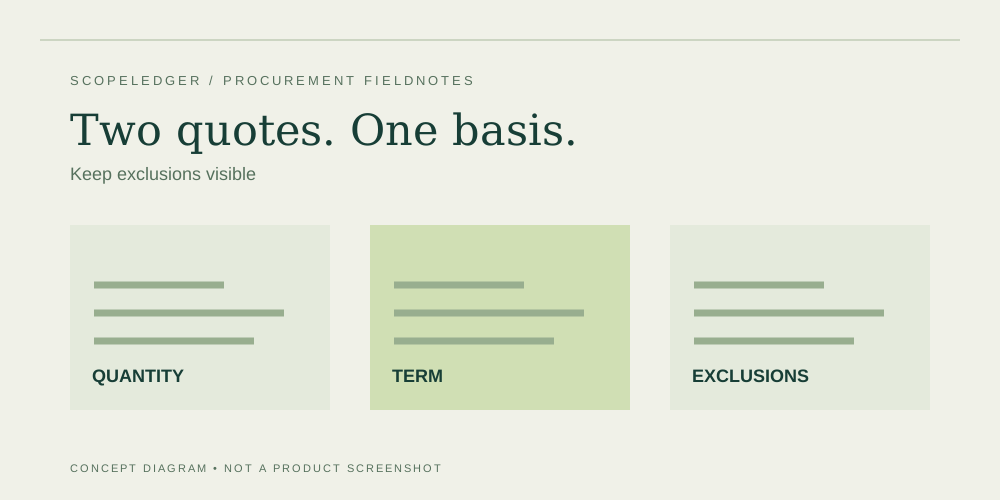
Normalize ERP quotes by preserving each original proposal and translating it into a common buyer-owned worksheet. Use the same horizon, scope, user roster, and treatment of one-time and recurring charges. Do not overwrite missing information with a guess: label it unpriced, assign an owner, and request a written answer.
Freeze a comparison version
Choose a scope version and an evaluation date. Record the user roster, required processes, legal entities, locations, interfaces, reporting requirements, and rollout phases. Suppliers may submit different revisions as negotiations progress; give each a clear identifier. A spreadsheet that mixes the first quote's implementation fee with a later quote's discount can produce a total that no supplier has actually offered.
Separate the quoted amount from the normalized amount. The normalized view may spread an annual payment across a multi-year comparison or add a buyer-estimated cost for an exclusion. Label the adjustment and its evidence. Never present a buyer estimate as a binding supplier commitment. Keep an explicit “not yet priced” status for a requirement where even an estimate would be misleading.
Use consistent columns
| Column | What it prevents |
|---|---|
| Scope reference | Comparing different deliverables |
| Quantity and unit | Confusing seats, entities, and transactions |
| Billing cadence and term | Mixing payment timing with commitment |
| One-time or recurring | Multiplying implementation every year |
| Included, excluded, or unclear | Treating silence as inclusion |
| Source and confidence | Hiding assumptions inside a total |
Add currency and tax treatment. US businesses with international entities should also record which entity signs and pays. Exchange assumptions belong in a separate scenario rather than being buried in a conversion cell. Have finance review the treatment of tax, allocation, and capitalized versus expensed amounts where those distinctions affect the decision.
Work through a scope gap
Suppose an illustrative Quote A includes $30,000 implementation and two interfaces. Quote B includes $25,000 implementation but no interfaces. The unadjusted difference is $5,000, but it is not a like-for-like saving. Ask Quote B's supplier to price the same interface scope. If a written addendum prices it at an illustrative $8,000, B's comparable delivery cost becomes $33,000.
Do not add a generic “integration allowance” and claim the problem is solved. The $8,000 only makes sense if direction, fields, volumes, error handling, testing, and support responsibilities match. If those details remain unclear, retain a scope risk alongside the arithmetic. A comparison should reveal what you know and do not know, rather than convert uncertainty into a deceptively precise total.
Keep cash timing separate from total cost
An annual prepayment and monthly billing can have the same nominal annual amount while creating different cash needs. Show a payment schedule for material invoices and a cost summary for the agreed horizon. If the organization uses discounted cash flow, have finance supply the method and rate. Do not invent a discount rate merely to make a spreadsheet look sophisticated.
Check the period boundaries. Does implementation begin before subscriptions are activated? Does a reduced first-term price end before the budget horizon? Are new users prorated or committed through another anniversary? Partial-year charges can be modeled in a supplemental schedule. The simple whole-year calculator should not be made to imply it handles every billing arrangement.
Review the final reconciliation with suppliers
Send each finalist the relevant normalized lines and ask them to identify misunderstandings. This is particularly useful for bundled services, mandatory dependencies, and minimum quantities. Preserve their reply with the proposal version. A clarification that changes the commercial offer should be reflected in the final signed documents, not merely an internal spreadsheet note.
Before approval, reconcile the worksheet total to the final order form and statement of work. Have a second reviewer reproduce a sample calculation without using your formulas. Review the assumptions that drive the biggest differences and the exclusions that could invalidate the result. The final decision should acknowledge any residual scope differences instead of disguising them as perfect comparability.
Approval worksheet
Use a final arithmetic audit with a reviewer who did not build the worksheet. Ask them to reproduce annual subscription, horizon cost, one-time delivery, and the treatment of at least one exclusion. Review hidden rows, stale references, mixed currencies, and formulas copied from another proposal. Make sure a blank or unknown value has not become zero through spreadsheet behavior.
Freeze the approved comparison with a date and version, while preserving the editable working file separately. Attach the exact source proposals and clarifications used. If negotiations change scope, repeat the affected calculations and obtain renewed approval where the organization's rules require it. A normalized worksheet is a decision instrument, not a replacement contract. Its value comes from the traceable relationship between each input and an actual document or explicitly labeled assumption. Keep that relationship intact when summaries are copied into presentations or funding requests.
FAQ
Can I compare a fixed-fee and time-and-materials proposal?
Yes, if you disclose the different risk allocation and model a supported effort scenario. A time-and-materials estimate is not the same commitment as a fixed scope and fee. Compare forecast-to-complete practices and change rules.
What should I do with an unpriced requirement?
Leave it visible and seek a written price or bounded discovery task. Do not enter zero. If the requirement is mandatory, commercial approval may need to wait for the uncertainty to be resolved.
Should tax be in the comparison?
State the chosen basis and apply it consistently. The correct tax treatment can depend on jurisdiction and transaction details. Ask the organization's tax or finance adviser rather than assuming every ERP purchase has the same treatment.
Sources
- Microsoft Business Central pricing — an official reference for distinguishing advertised payment cadence from project scope.
Continue the workbook
- ERP buying checklist: from requirements to approval
- ERP business case: separate cash savings from capacity
- ERP demo checklist: test workflows instead of slides
Use the ERP total cost calculator for your own scenario, the quote readiness checklist to track evidence, and the cost structure comparison to review purchasing models.